
Thermal Imaging Leak Detection in Round Rock, TX
An infrared camera does not detect water directly. It reads surface temperature, and water leaves a temperature signature: wet areas cool by evaporation, creating a pattern the camera reads clearly through drywall, ceiling tiles, and finished surfaces without opening anything.
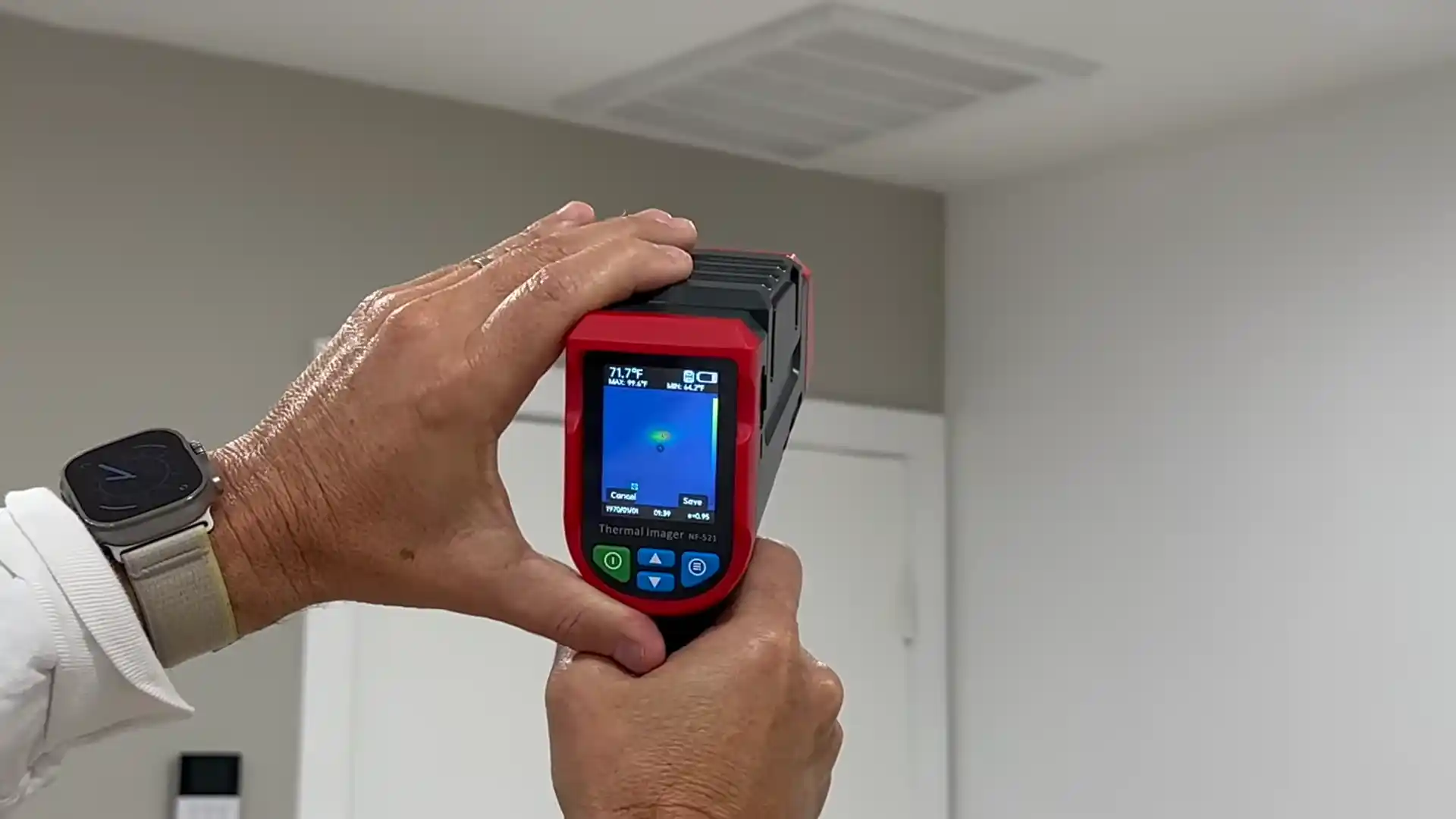
How wet areas appear on infrared
Evaporation cools a surface. A wet area behind a wall or above a ceiling tile is measurably colder than the surrounding dry material, often by one to three degrees. That contrast shows as a distinct, readable cool region on the infrared image, even through a finished drywall surface. The shape of that region tells a story. A streak running down a stud bay toward the baseboard points at a supply line. A radial spread from a single ceiling point suggests a drain or fixture above. A band along a wall base may follow the pipe run. Reading that shape narrows the investigation before any surface opens.
In Round Rock two-story homes from the 2000s, a first-floor ceiling stain with no obvious upstairs source is exactly the scenario thermal imaging was built for.
Interpreting the camera image
Thermal imaging requires interpretation alongside the scan. A cool wall patch can come from a pipe leak, but it can also come from a gap in exterior insulation, a cold-air infiltration path at a penetration, or an intentionally empty wall cavity. We read the pattern in context: is the cool area aligned with a known pipe run? Does its shape match a leak or a draft? Does a moisture meter confirm actual dampness at the surface? The camera produces the hypothesis; the meter and pipe map confirm it before we commit to any opening.
If a ceiling or wall has a stain with no obvious source, call (512) 737-6168 and a thermal scan is typically the first step before any plaster comes down.
Where it works and where it does not
Thermal imaging excels at leaks behind drywall and above ceiling tiles, where active dripping has had time to wet the material and create a readable temperature contrast at the surface. It is less effective on concrete slabs, where the thermal mass and underlying soil dampen any temperature change before it reaches the slab surface, and it requires an active wet area at scan time. A leak that dried last week leaves little thermal trace; one that dripped overnight shows clearly the following morning.
Pairing the camera with a moisture meter
The infrared scan narrows the area; the moisture meter confirms it. A pinless meter held against a cool wall spot registers whether the material is genuinely saturated or simply cold from an air source. When both instruments agree on a location, we make one targeted access cut there rather than opening the wall to search. That sequence keeps the repair scope tight, which matters especially in a finished room where the drywall patch after the plumbing is often the more visible part of the job. Getting the locate right the first time means doing the opening once rather than twice.
Why Central Texas conditions help
The ambient climate in Round Rock works in favor of thermal imaging. An air-conditioned interior against a hot exterior creates a strong baseline temperature contrast, so even a small wet area reads noticeably cooler than surrounding dry drywall. The long hot summers here mean that contrast is present for most of the year. In winter, the reading flips: a wet area holds thermal mass and appears slightly warmer against a cold exterior wall. Either season, the method works. Call (512) 737-6168 when a stain needs a precise locate before any surface opens.
Not sure what you are dealing with? Talk it through.
📞 (512) 737-6168Frequently Asked Questions
Does the infrared camera actually see water?
No. It reads surface temperature. Wet material is cooler than dry material because water evaporates and cools the surface. That temperature difference is a reliable indicator of where moisture is present.
Can thermal imaging find a slab leak?
Less reliably than ceiling or wall leaks. Concrete's thermal mass dampens the temperature change before it reaches the surface. Acoustic and tracer gas methods are usually more effective for slab leak location.
Is the camera alone enough to find the leak?
Usually not without a moisture meter to confirm. The camera narrows the area and the meter verifies actual dampness. Together they give a confident locate for a small, targeted access cut.
Related leak services
Brown rings and sagging drywall fed by a leak from above.
View → WallDamp drywall and bubbling paint from a leak inside the wall.
View → Ultrasonic DetectionHigh-frequency contact probes detect leaks in walls and above-ground pipe.
View →Browse all 54 services Areas we cover · Leak guides on the blog