
Ultrasonic Leak Detection in Round Rock, TX
Ultrasonic detection reads above 20 kilohertz, the range human hearing does not reach. A pressurized leak generates turbulent energy across that band, and a contact probe placed on a pipe or wall surface picks it up directly, without needing soil to carry the signal.
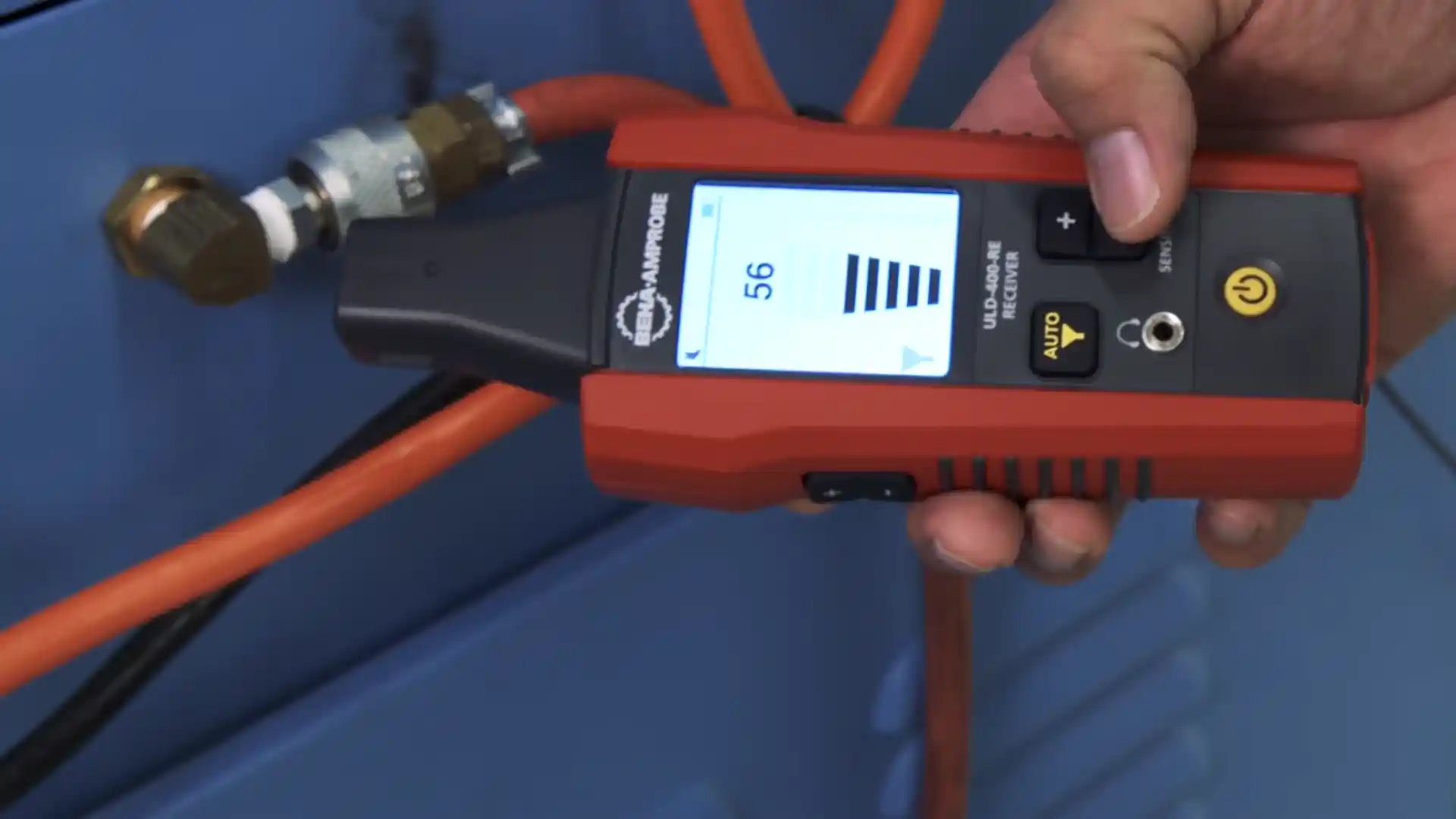
What happens at the leak orifice
When pressurized water forces through a small breach, the turbulent flow radiates energy across a broad frequency spectrum. The low end, below one kilohertz, is what ground acoustic microphones hear through soil. The high end, above 20 kilohertz, is what an ultrasonic transducer reads when pressed against a pipe surface or a wall panel. Both frequency bands carry the same leak information but couple differently to different surfaces and require different sensors to capture them.
On above-ground pipe, shutoff manifolds, and supply connections inside walls, the ultrasonic probe gives a direct surface reading with no dependence on soil coupling at all.
Contact probes and airborne sensors
Ultrasonic equipment comes in two forms. A contact transducer pressed against a pipe wall, concrete surface, or drywall panel reads the high-frequency energy the structure itself carries. An airborne ultrasonic sensor detects the component that radiates into open air from an exposed fitting, valve, or pressurized enclosure. We carry both and choose based on what is in front of us: contact for structural surfaces, airborne for open fittings and cabinet spaces where contact is not practical.
If a supply manifold, a valve bank, or a visible pipe section is under suspicion, call (512) 737-6168 and ultrasonic is usually the clearest diagnostic approach.
Where it outperforms acoustic ground work
The acoustic ground microphone is the right tool for buried supply lines in soil. Ultrasonic surpasses it in three situations. On above-ground or in-wall pipe where soil coupling does not exist and a contact probe can reach the surface directly. In environments with heavy low-frequency background noise that masks the acoustic band. On short, accessible pipe runs where a surface-contact confirmation is faster and more precise than digging to expose the line for direct listening. A valve that has been repaired twice and keeps weeping is a good candidate: press the probe to the valve body and the signal points directly to the failed seal without touching anything else.
Using it on walls and ceilings
For pipe running inside a wall, the ultrasonic probe sweeps along the drywall surface. The reading peaks where the leaking pipe is closest to the face of the wall, providing a locate precise enough to mark a single access cut rather than opening a wider section. In Round Rock homes from the 1980s and 1990s, hard-water pitting in copper supply lines is common. A slow pinhole in a wall cavity is exactly the situation where surface ultrasonic replaces a broad exploratory opening with a small, targeted one.
Combined with acoustic and thermal imaging
Ultrasonic typically works alongside the other detection methods rather than replacing them. It handles the above-ground pipe segment that neither acoustic nor thermal can reach as effectively.
Acoustic and thermal imaging cover the buried and moisture-pattern sides of an investigation. Ultrasonic takes over at the pipe surface when those methods have narrowed the search but need a final contact confirmation at a specific point. Acoustic and thermal imaging cover the buried and moisture-pattern sides of an investigation. Ultrasonic takes over at the pipe surface when those methods have narrowed the area but need a contact confirmation at a specific point. A full in-wall investigation typically runs thermal for the moisture map, acoustic for any buried segment, and ultrasonic for the pipe surface confirmation. Call (512) 737-6168 if a wall or manifold leak needs a precise final locate.
Not sure what you are dealing with? Talk it through.
📞 (512) 737-6168Frequently Asked Questions
How is ultrasonic different from acoustic detection?
Acoustic uses low-frequency ground microphones that pick up vibration through soil. Ultrasonic uses high-frequency contact probes on pipe or wall surfaces. They cover different frequency bands and different surface types.
Can ultrasonic find a leak behind drywall?
Yes. A contact probe swept along the drywall peaks where the leaking pipe is closest to the surface, giving a precise location for a small access cut rather than a wide exploratory opening.
Do you use ultrasonic on every job?
Only where it suits: above-ground pipe, in-wall runs, valve manifolds, and noisy environments. It is a precision tool used to confirm and refine, not the first step on every investigation.
Related leak services
Damp drywall and bubbling paint from a leak inside the wall.
View → PinholeHard-water pitting in copper, common in 1980s and 1990s homes.
View → Thermal Imaging DetectionAn infrared camera reads temperature differences to find wet areas behind surfaces.
View →Browse all 54 services Areas we cover · Leak guides on the blog